ETCOG’s Rural Transportation Planning Organization Announces Major Development In I-20 Corridor Intercity Passenger Rail Service
East Texas Council of Governments • December 19, 2023
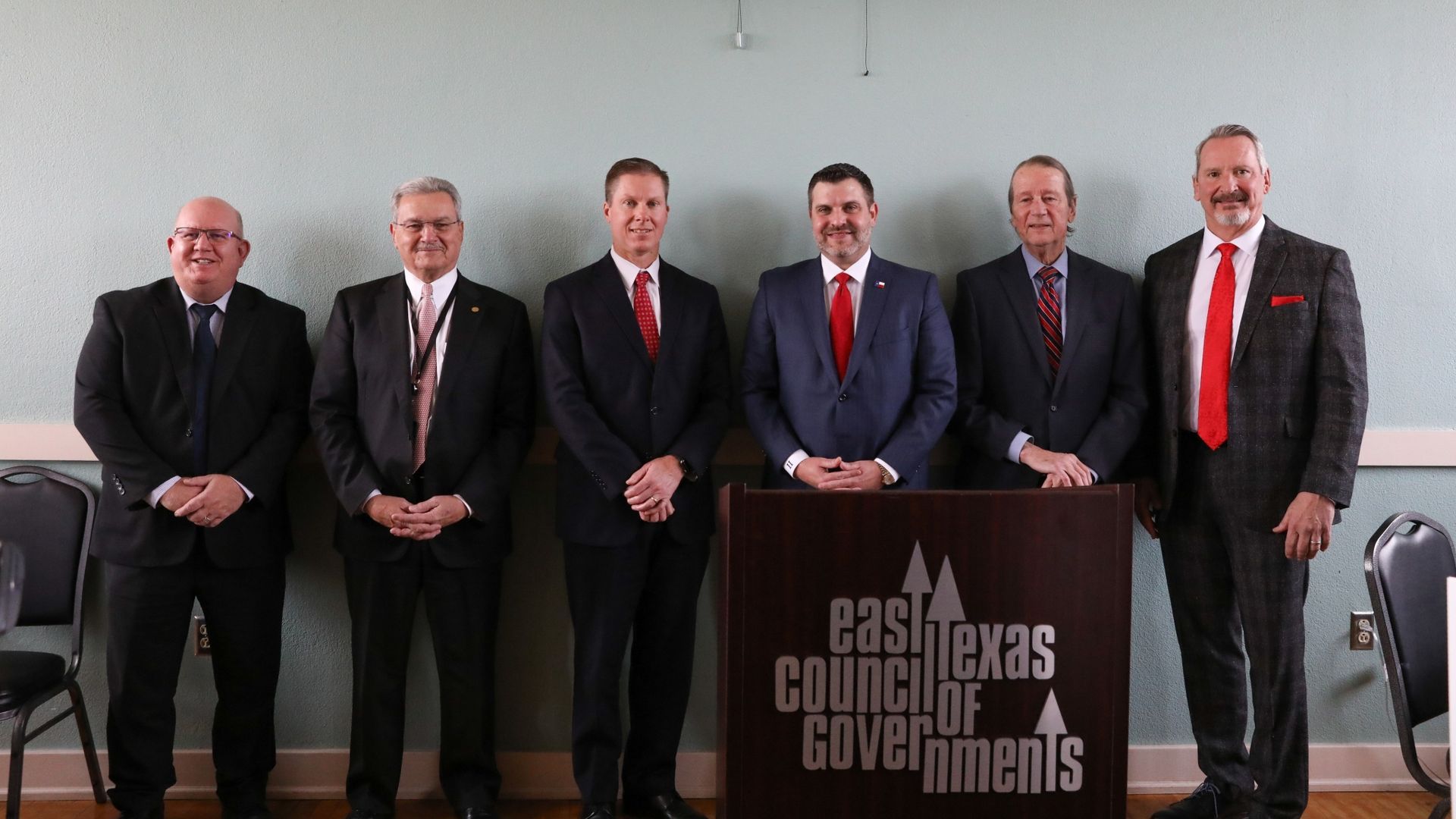
a group of men standing in front of a east texas council of governments podium

Pictured left to right: RTPO members Wood County Judge Kevin White, Gregg County Judge Bill Stoudt, Harrison County Judge Chad Sims, Chairman Marion County Judge Leward LaFleur, former Harrison County Judge Richard Anderson, and Smith County Judge Neal Franklin 

ETCOG’s Rural Transportation Planning Organization (RTPO) hosted a press conference today partnered with the City of Longview to reveal that the Federal Railroad Administration (FRA) has officially designated the I-20 Corridor Intercity Passenger Rail Service as one of the selected corridors for the FRA’s FY22 Corridor Identification and Development Program (CIDP). This marks a significant milestone for the long-advocated rail connection between Dallas/Fort Worth and Atlanta, Georgia.


The I-20 Corridor long-distance passenger rail connection between Dallas/Fort Worth and Atlanta, Georgia—through Mineola, Longview, Marshall, Texas, and northern Louisiana—has been advocated for and collaborated on by a coalition of county judges, mayors, local, state, and federal elected officials, and grassroots advocates, for nearly 17 years.


The press conference was held at 2:00 p.m. at the Longview Depot/Multi-Modal Transportation Center, where Chairman of the RTPO, Judge Leward LaFleur, RTPO member and project advocate, Gregg County Judge Bill Stoudt, and project advocate, former Harrison County Judge Richard Anderson, provided details on this accomplishment. 


“This Corridor grant designation by the FRA, connecting Dallas/Fort Worth through East Texas to Meridian, Mississippi, is a significant step forward for the full I-20 long-distance rail route that is envisioned between Dallas/Fort Worth and Atlanta, Georgia, and connecting with the East Coast and New York City,” said Chairman, Judge Leward LaFleur, “East Texas is the perfect route for this project, allowing the development of new services to align on existing infrastructure.”


"This is outstanding news for our region and all communities along the I-20 Corridor. The east-west connection across our southern region will bring significant benefits to both urban and rural areas. We thank all who have dedicated themselves to reaching this important milestone," said Judge Bill Stoudt. “We also want to thank Amtrak, as always, for their very valued and continued partnership and collaboration for our Amtrak Served Communities in East Texas, as well as communities throughout Amtrak's National Network. We look forward to the continued collaborative efforts going forward.”


The I-20 Corridor Intercity Passenger Rail Service is set to serve various cities in Texas, Louisiana, and Mississippi. To seek funding for this effort, an application was submitted by the Southern Rail Commission, which was successfully awarded $500,000 for Step 1 of the program.


A recent press release from Congressman Nathaniel Moran also emphasized the importance of the investment, stating, “Improving East Texas’ infrastructure and connecting the First District to metropolitan areas along I-20 is an essential effort for ensuring long-term growth and prosperity. This investment will help better position Mineola, Longview, and Marshall for future economic opportunities and growth. I have seen firsthand the positive effects of investing in our railroads, and I will continue to work with our local leaders to advocate for programs that better our infrastructure and strengthen our economy.”


The I-20 Corridor project is classified under the FRA’s New Conventional Rail category, operating at speeds of up to 79-125 mph, primarily on existing rail alignments shared with other railroad operations.


Funding for the FRA’s Corridor ID program was allocated by the Infrastructure Investment and Jobs Act (IIJA), passed by Congress and signed into law by President Biden on November 15, 2021. The IIJA allocated $66 billion for rail, including $16 billion for long-distance passenger rail routes, such as the I-20 Corridor.


"This designation by FRA is a significant step and puts the I-20 Corridor long-distance passenger rail project in line for the next phases of substantial funding to move toward implementation of service. We thank all governmental agencies, federal, state, and local elected officials, grassroots advocates, and other stakeholders who worked together for many years to make this important milestone possible,” commented Judge Richard Anderson.


About the RTPO

The East Texas Rural Transportation Planning Organization includes representation of judges from 14 counties, mayors from the City of Longview and Tyler, and TxDOT engineers for the region. The Board develops strategic plans and strategies for ETCOG and plans for regional transportation projects. Former Harrison County Judge Richard Anderson and Judge Stoudt played a crucial role in the establishment of the RTPO in 2009 in collaboration with ETCOG. In 2007, a coalition of County Judges and officials from the 14-county ETCOG region sought support for the I-20 Corridor passenger rail project. They reached out to the North Central Texas Council of Governments, representing the Dallas/Fort Worth metroplex, and also engaged elected officials and stakeholders in northern Louisiana through ETCOG and the Corridor Council. Joint Memoranda of Understanding was signed in 2007, 2008, and 2009 by ETCOG, NCTCOG, Northwest Louisiana COG, and North Delta COG, endorsing the I-20 Corridor route through Mineola, Longview, Marshall, and northern Louisiana.


About I-20 Corridor Council

The I-20 Corridor Council was formed to re-establish passenger rail service along the Interstate 20 Corridor, connecting Fort Worth, Texas, to Atlanta, Georgia, through northeast Texas, northern Louisiana, and Central Mississippi, also connecting to Washington, D.C., and New York City. The efforts in support of this route commenced in 2004 and gained momentum in 2007 with the assistance of renewed grassroots volunteer efforts and federal grant funding. Originally designated as the East Texas Corridor Council and then the Ark-La-Tex Corridor Council, as grassroots efforts built and a multi-state coalition grew to include Louisiana, Mississippi, and other stakeholders along the route, the name was changed to the I-20 Corridor Council. Learn more at www.i-20corridorcouncil.com.


Narrow stream flowing through tall green grass in a sunny field
By Texas Department of Agriculture July 13, 2026
TDA is pleased to see interest from many communities in the upcoming 2027 Texas Community Development Block Grant applications. No action is required for communities at this time; however, here are several items that may be useful as you look forward to the release of grant applications this fall: Save the Date for your local governing body resolution. All TxCDBG grant applications require a resolution adopted by the local governing body to authorize submittal of the application, commit to adhere to the requirements of the TxCDBG program, and commit matching funds, if applicable. TDA recommends marking your calendar to complete this task at your October 2026 meeting. The required resolution language will be provided in the Application Guide, to be released in September 2026. Procure a grant administrator. Many Grant Recipients hire a consultant to be responsible for grant administration and reporting requirements. If your community would like to have a grant administrator also assist in preparation of the grant application, the services contract must be competitively procured prior to any participation by the firm in the application process. TDA has compiled a user-friendly guide to procuring a grant administrator according to TxCDBG policies: Solicitation and Contract Documents for Administration Services* Contracts The Unified Scoring Committee will determine at its meeting in September whether to offer an annual or biennial cycle for the Community Development Fund – the sample documents in this guide account for both options. A similar guide for engineering procurement will be made available later this fall. No engineering work is required for the first phase of the application process. Attend your regional meeting to establish Project Priorities (or review the adopted priorities once posted). Consider the projects important to your community in each of the Priority 1 categories, as well as other projects that are important to your community. ETCOG's regional meeting will be held Thursday, August 6, 2026, at 12 noon, at ETCOG headquarters TDA’s default priorities can be used as a reference for the available project categories; each region will identify its own priorities within this structure: 2027 Regional Project Priority Scoring Element - Default.pdf
By East Texas Council of Governments July 13, 2026
ETCOG will hold a Public Hearing on Thursday, August 6, 2026, at 12:00 p.m. during its Executive Committee meeting at 3800 Stone Road, Kilgore, Texas. The purpose of the hearing is to gather public input on the Texas Community Development Block Grant ( TxCDBG ) Program Regional Project Priority Types for the East Texas region. As part of the standard TxCDBG process, each Council of Governments region in Texas is encouraged to identify the project types that best reflect regional needs and priorities. During the hearing, ETCOG’s Executive Committee will receive comments from local officials, stakeholders, and members of the public regarding which eligible project categories should be prioritized for East Texas. These priorities may include needs such as water and sewer infrastructure, street improvements, housing, and other eligible community development activities. Regional project priority types play an important role in the TxCDBG application process. The priorities adopted by ETCOG will be submitted to the Texas Department of Agriculture (TDA), which administers the TxCDBG program, for use in the upcoming funding cycle. Regional priorities account for a portion of the scoring used to evaluate grant applications. ETCOG encourages anyone with an interest in community development needs across East Texas to attend the hearing and provide input during the public comment period. 
By Texas Parks and Wildlife July 10, 2026
The CO-OP Grant team will host a series of Grant Application Workshops to cover all the elements needed for a competitive application. Offered both online and at sites around the state, the workshop will provide application support and assist potential applicants with an overview of the application process, grant program requirements and priorities, scoring criteria, budget planning and eligible grant expenses, and answer questions from applicants. Opportunities for in-person project consultation appointments with grant staff will also be made available at the site-based workshops. The CO-OP Grant will begin accepting project proposals August 3, 2026, through October 1, 2026, at 5 pm CST. Grant Awards will be announced March 1, 2027, and programs will take place over 18 months. Eligible projects should engage program participants in areas of conservation, outdoor recreation, and environmental education and connect participants to TPWD sites, programs, and staff. Grant funding can support personnel, training, travel, food, fees, and supplies. There is no match requirement. This grant supports outdoor programs for populations that are under-served. The CO-OP grant does NOT fund any type of construction, trails, boat ramps, or vehicles. This is a reimbursement grant. REGISTER To attend at workshop, complete the online registration at: https://www.signupgenius.com/go/10C0F4BA5AD2DA1F5C16-64420560-tpwd#/ ONLINE WEBINAR Monday, July 20th 2 p.m.- 4 p.m Live (Recording will be available on/after 7/22)
By Texas Commission on Environmental Quality June 5, 2026
$16.5 Million in Grants Available
By USDA Rural Development June 2, 2026
The U.S. Department of Agriculture has announced that it is making $27.7 million in grants available through the Rural Business Development Grant Program (RBDG). This program provides funding for business and community initiatives that promote economic growth and job creation. Eligible applicants can include rural cooperatives, state government agencies, towns, and communities, nonprofit corporations and institutions of higher learning, and federally recognized Tribes. Individuals and for-profit businesses or organizations are not eligible to apply. Applications will compete in two separate categories: Business opportunity grants: May be used for business support centers, technology-based economic development, leadership and entrepreneur training, feasibility studies, business plans, long-term strategic planning, and other eligible activities. Business enterprise grants: May be used for training and technical assistance, project planning, business counseling, market research, feasibility studies, and product or service improvements, buying or developing land, easements, or rights of way, including access streets and parking areas, constructing or renovating buildings, and buying machinery and equipment, capitalizing revolving loan funds, and supporting rural business incubators and community economic development and other eligible activities. Electronic applications must be submitted by 4:30 p.m. local time through Grants.gov on the due date. The Rural Business Development Grant Program has two different closing dates: June 15, 2026, only applies to Strategic Economic and Community Development (SECD) applications. June 30, 2026, applies to the remainder of the applicants. For more information on how to apply please visit on gov or contact your local USDA Rural Development office .
May 19, 2026
Freedom 250 Event Celebrates Free Enterprise Through National Small Business Competition for $1 Million Cash 
By East Texas Council of Governments April 30, 2026
Many of our communities have properties that are abandoned or underutilized because of suspected environmental contamination from past uses. These properties are commonly referred to as “Brownfields.” Redeveloping a brownfield site does more than change the look of a property; it strengthens the health, economy, and spirit of the whole community. Through ETCOG’s Brownfield Site Reuse & Revitalization Program, local governments and property owners can receive no-match funding to assess and plan for the safe reuse of vacant or underused sites. Projects can include environmental studies, market analyses, community engagement efforts, and much more, that set the stage for growth while protecting public health and the environment. Every successful project begins with identifying potential sites. If your community has a property that could be brought back to life, now is the time to act. Find details and a site nomination form at www.etcog.org/brownfields-program .
Sunset over a calm lake with clouds reflected in the water and a tree-lined shore
By Texas Water Development Board April 29, 2026
This is an announcement shared from Texas Water Development Board
By Civic Marketplace April 28, 2026
Today, the East Texas Council of Governments (ETCOG) announced the award of Civic Marketplace as the technology platform for COGWORKS, its cooperative purchasing arm. The partnership will leverage cutting-edge technology and artificial intelligence to support regional purchasing for rural communities, school districts, and local governments across the East Texas region, state, and nationwide. For more than 50 years, ETCOG has supported East Texas through regional planning, coordination, and shared services. COGWORKS was established in response to member demand for dependable cost-control solutions that serve jurisdictions of all sizes through competitively awarded cooperative contracts. This collaboration strengthens COGWORKS by improving shared buying, administrative coordination, and visibility into contract activity, enabling members to operate more efficiently while meeting procurement requirements. “This partnership supports our responsibility to ensure rural communities, schools, and local districts can access purchasing programs that deliver measurable savings and efficiencies,” said David Cleveland, Executive Director of ETCOG. “COGWORKS allows participants to benefit from collective buying power and shared procurement expertise through a program they know and trust.” Civic Marketplace will partner with ETCOG to activate and operate COGWORKS on its digital platform, in order to expand participation and deliver measurable value to member agencies across East Texas. Through its purpose-built technology platform, proprietary artificial intelligence (AI) agentic, solutions, and hands-on program enablement, Civic Marketplace will support contract visibility, supplier onboarding, entity activation, and ongoing program analytics at no cost to member agencies. “This partnership demonstrates ETCOG's commitment to building a strong, sustainable cooperative purchasing ecosystem for East Texas,” said Al Hleileh, CEO and Co-Founder of Civic Marketplace. “Our goal is to help COGWORKS increase utilization and transparency of cooperative contracts, elevate local businesses, and deliver regional efficiency.” “Civic Marketplace was born in East Texas, with deep roots in the cities of Longview and Tyler,” added Ron Holifield, Co-Founder and President of Civic Marketplace. “Our partnership with COGWORKS is both a homecoming and a new wellspring for these communities, bringing together collaborative purchasing and cutting edge technology to help local government entities better serve their residents.” As COGWORKS continues to grow, ETCOG and Civic Marketplace will work together to expand contract offerings, support supplier participation, and provide members with the tools and information needed to use cooperative purchasing effectively. About Civic Marketplace Civic Marketplace is the AI procurement platform built for local governments and free for every SLED entity to use. By removing cost as a barrier, we make it easier for cities, counties, and school districts to modernize how they buy goods and services without adding strain to already tight budgets. Our platform connects government buyers to a network of pre-approved suppliers, ensuring every contract meets compliance and quality standards from the start. We're especially committed to expanding access for historically underutilized businesses, helping local governments support regional suppliers and strengthen the communities they serve. Procurement doesn't have to be slow, complicated, or expensive. Civic Marketplace is backed by venture investment and built to prove it.  Learn more at civicmarketplace.com
Show More